The Plan and the People

We have come to a point when we make decisions about people moves at increasing speed. We hire, promote, succession plan, and forecast workforce using systems that learn from the record we have kept. But here is the glitch, most of that record was written inside conditions that decided who got to practice leadership long before anyone measured it. With these accelerated tools, the assumptions underneath them deserve the same scrutiny. Perhaps, they require more.
plans that begin with the people already in the room
We have workforce planning that asks what work the organization needs done and what capability that work requires, while talent management asks who its people are and what they can become. Pulled apart, the plan treats people as headcount, sourcing skills on demand and paying a premium for capability it could have grown, while the talent strategy develops people toward nothing in particular, rating potential with no destination in sight. So here we are with each discipline answering half of the same question. Know this… the organizations that hold these disciplines together are the ones that read today’s roster and tomorrow’s requirements side by side and let that read decide what kind of hire comes next.
Let’s glance inside a twenty-person shop I had the privilege of working with. The organization had weathered steady turnover in a competitive market, yet two individuals had stayed through it all. Both were excited about the work but lacked a clear path for growth. Through workforce planning and talent mapping, we identified their aspirations and made creating opportunities for their development a priority that would shape subsequent staffing decisions.
When the plan called for a team director, we made the mandate explicit from the first hiring conversation: developing internal talent would be a core expectation of the role. The incoming director would also be responsible for planning and budgeting for the team's progression, including leveling and future external hires.
This is the house that the two functions create together.
conviction that capability is built
Talent management carries an inheritance. Much of it is designed to identify what tendencies already exist in a person, including personality, strengths, aptitude, leadership style, potential, and executive presence, and then to use those findings to decide who gets developed, sponsored, and promoted. Understanding those tendencies has value, but the risk arrives when description quietly becomes destiny.
History has run this experiment before. For centuries, the British class system tied birth to education, apprenticeships, professions, and positions of authority, along with fixed expectations about who was suited to lead. The system created its own evidence, since the people given access to environments that cultivate leadership went on to demonstrate it and the people kept outside had fewer chances to practice. Over time, position began to look like capacity. The modern workplace still runs a version of that loop whenever it observes people inside conditions it created, names the ones who thrive as naturals or a cultural fit and concludes that the ones who struggle lack the right traits. Pause on boundaries this type of thinking fosters. When a talent system measures only what people have already had the opportunity to demonstrate, it risks mistaking access for aptitude.
In reality, where someone sits tells us something about what they have had the opportunity to practice. The question for talent management is what we are prepared to help them practice next.
fluency in reading conditions
Pattern Literacy treats leadership as practiced behavior within a set of conditions. It replaces the question of what kind of leader someone is with a sharper one: what pattern is this person practicing, under what conditions, and to what effect? Patterns are practiced responses, which means they can be strengthened, regulated, and expanded.
Once range can be built, the workforce plan gains a third column. Alongside what the business needs and what it currently has sits what its people could become with deliberate practice.
Learn to read the third column
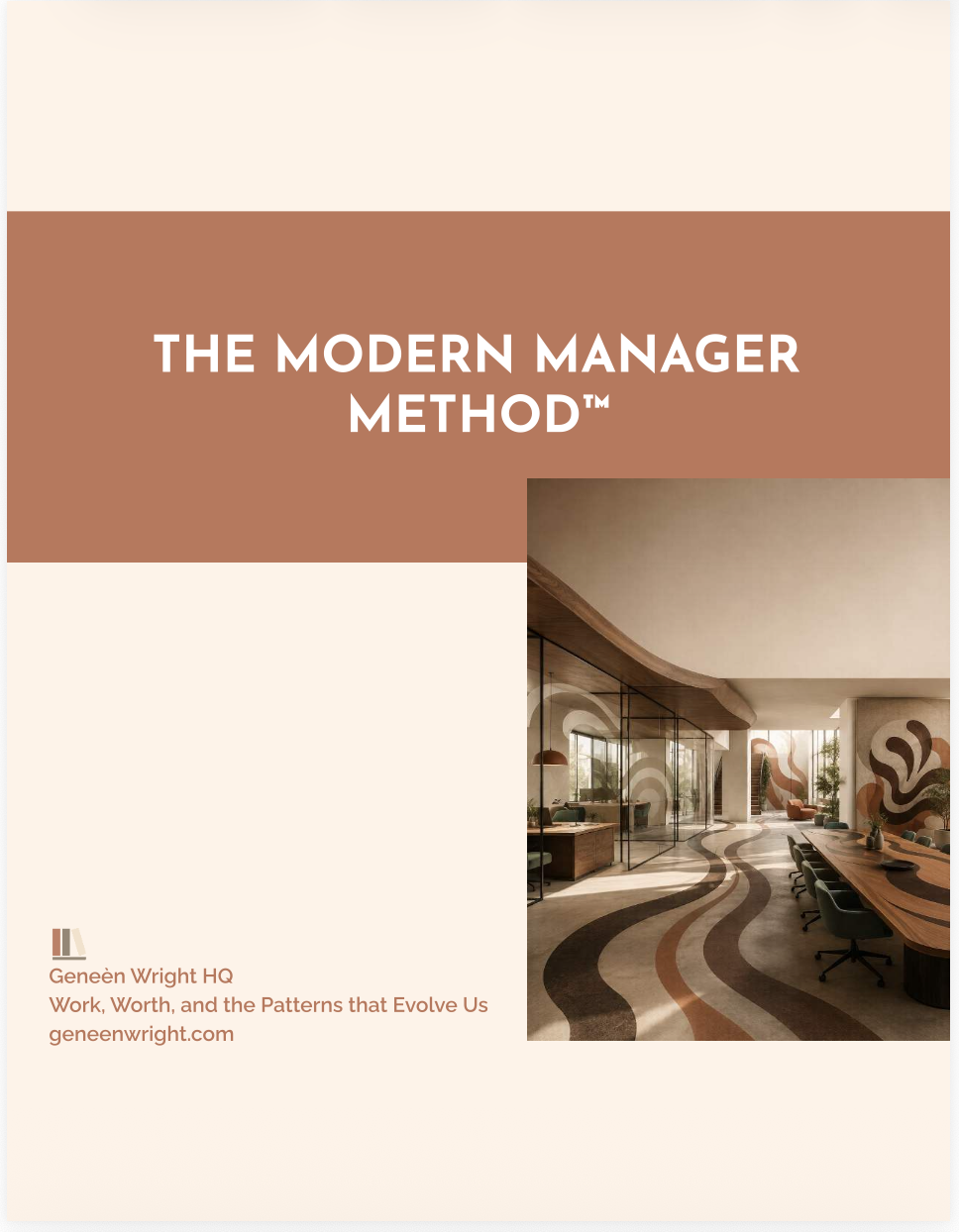
The Modern Manager Method™ workbook gives you the frameworks to read the patterns you lead with, the conditions shaping them, and the range you and your team can build next. For organizations ready to practice it together, team workshops are scoped to the system you’re operating inside.
That third column changes the planning conversation. A capability gap becomes something to examine before it becomes a requisition. Leaders have to determine which capabilities can be developed internally, what conditions would make that development possible, and how long the business can afford to wait. Some gaps will still require external hiring. Others may reveal that the capability the organization needs is already within reach, provided someone takes responsibility for developing it.
accountability for growth, held at every level
How often has "They aren't ready" been followed by "And this is what they need to be ready"?
That statement assigns work to everyone involved. The individual practices range. The manager teaches, observes, and creates room to practice, which makes manager capability a piece of infrastructure the organization depends on. The organization owns the conditions it creates and the behaviors those conditions reward, tolerate, and punish.
Is this the utopia of workplace design? Is it even possible in a fast-moving buildout culture?
I would argue it is especially necessary there. Growth exposes every capability gap an organization has deferred addressing. Without a deliberate approach to development, each new stage of growth creates another round of external hiring, another layer of dependency, and another scramble for readiness.
When you build with future readiness in mind, you build for scale.
More human judgment as the machines arrive
As AI becomes embedded in how organizations hire, evaluate, promote, and plan. I mentioned at the top of this piece that the predictive systems we increasingly rely on draw conclusions from historical records. Let me elaborate, in talent management that record is the history of who got hired, rated high potential, stretched, and promoted. Reuters reported in 2018 that Amazon scrapped an experimental recruiting tool after it learned to penalize résumés containing the word “women’s,” having been trained on a decade of applications to a technical workforce that skewed heavily male. Research by Alan Benson, Danielle Li, and Kelly Shue found that at a large retailer, women received lower potential ratings than men despite earning higher performance ratings, a gap that explained much of the difference in promotions. These are the records we are asking machines to learn from. A history of decisions shaped by the conditions of their time, now capable of informing decisions at extraordinary speed.

The responsibility for what happens next belongs to the people designing and using these systems. We have to understand what the data represents, examine the conditions that produced it, and exercise judgment about the recommendations that follow. Otherwise, we risk building tomorrow's workforce using yesterday's ceilings.
Ready to build the third column across your organization?
Team workshops are scoped to the conditions your leaders operate inside..
The work ahead
I write and build about leadership as a public service, because every leader who learns to read the system is another shot at cleaning up the workplace and the systems within it.
Workforce planning tells an organization where it is going. Talent management, practiced as development and built into workforce modeling, is the grail. Together, they give us a way to plan for the work ahead while building the people who will do it.
And perhaps that is where the next generation of workforce strategy begins. With a plan that accounts for the people already in the room and what they have yet to become.
That is the grail.
¹ Jeffrey Dastin, “Amazon Scraps Secret AI Recruiting Tool That Showed Bias Against Women,” Reuters, October 10, 2018. https://www.reuters.com/article/us-amazon-com-jobs-automation-insight/amazon-scraps-secret-ai-recruiting-tool-that-showed-bias-against-women-idUSKCN1MK08G
² Alan Benson, Danielle Li, and Kelly Shue, “‘Potential’ and the Gender Promotion Gap,” American Economic Review 116, no. 2 (February 2026): 375–417. https://doi.org/10.1257/aer.20220831