
STRATEGIC PEOPLE ENABLEMENTAI Workforce Planning
&
Transition Strategy
For what AI changes beyond the task. For the workforce architecture around it.
Standard AI conversations start with:
What can be automated?
Which tools should we adopt?
Where can we gain efficiency?
Workforce strategy does not start with the technology. It starts with the conditions and behavior driving the need for change: What changed, and why? What are the domino effects of that change?
Every role is built from a collection of tasks. Around those tasks sit pipelines, capabilities, management expectations, and performance systems designed for the work as it existed before. When the work changes, that change moves through the infrastructure surrounding it and has to be met structurally.
AI Workforce Planning & Transition Strategy helps organizations read those shifts early, determine where current workforce infrastructure no longer fits the conditions, and plan what needs to change across roles, management, capability, and talent systems.

Follow the Change Through the System
AI workforce planning starts by tracing what changed and following the consequences through the organization.
That means asking:
What changed in the work, and what is driving that change?
Which tasks are being automated, augmented, consolidated, or newly created?
What does that change about the role those tasks sit within?
Which capabilities become more important, less necessary, or newly required?
What changes for the managers responsible for coordinating, evaluating, and developing that work?
Which assumptions embedded in hiring, performance, succession, and development no longer hold?
Where does human judgment need to remain explicit?
What needs to change first, and what should not change yet?
The objective is not to predict every consequence of AI. It is to understand how a change in the work travels through the system before organizational decisions harden around assumptions that no longer fit.
Where the Change Lands
A change in the work rarely stays contained to the work itself. The read follows its impact across five connected areas.
-
How work is currently distributed across roles and teams, which activities are changing, and where existing job architecture no longer describes the work accurately.
-
How managers coordinate, evaluate, develop, and make decisions around the work, and where changing conditions alter what management needs to provide.
-
What the organization knows how to do today, what it will need to know how to do next, and where those capabilities should be developed, hired, redeployed, or redesigned.
-
How hiring, performance, succession, and development systems reinforce the workforce the organization has today, and whether those systems can build the workforce it needs next.
-
What needs to move first, what depends on something else changing, and what should remain in place until the conditions warrant a different decision.
From Read to Response
-
Diagnose
Establish what is changing in the work, what is driving that change, and where current workforce infrastructure is already under pressure.
-
Architect
Translate those findings into implications for roles, management, capabilities, talent pipelines, and people systems.
-
Sequence
Determine what needs to change now, what depends on another move first, and what should be monitored before additional decisions are made.
Here, transformation goes beyond a buzzword. We build the response the conditions require, in the order the organization can sustain.
Results of the Read
The output depends on what the diagnosis reveals. The work can include:
Workforce scenario maps
Role and task impact analysis
Management-layer implications
Capability gap analysis
Build, buy, redeploy, and redesign recommendations
Succession and leadership-pipeline implications
Talent infrastructure recommendations
Organizational design considerations
Human-judgment checkpoints
A prioritized transition roadmap
The point is not to produce another AI strategy deck. It is to give leadership a clearer view of what the organization needs to build, protect, redesign, and sequence as the work changes.

If the work is already changing and the implications are beginning to surface across roles, management, or talent systems, we can start by reading the conditions together.
FIELD NOTEThe conditions become easier to see when you follow them through the systems already in place. These resources offer two ways into the work: assess the broader architecture, or see the read applied to a specific part of the workforce system.
The Read, Applied.
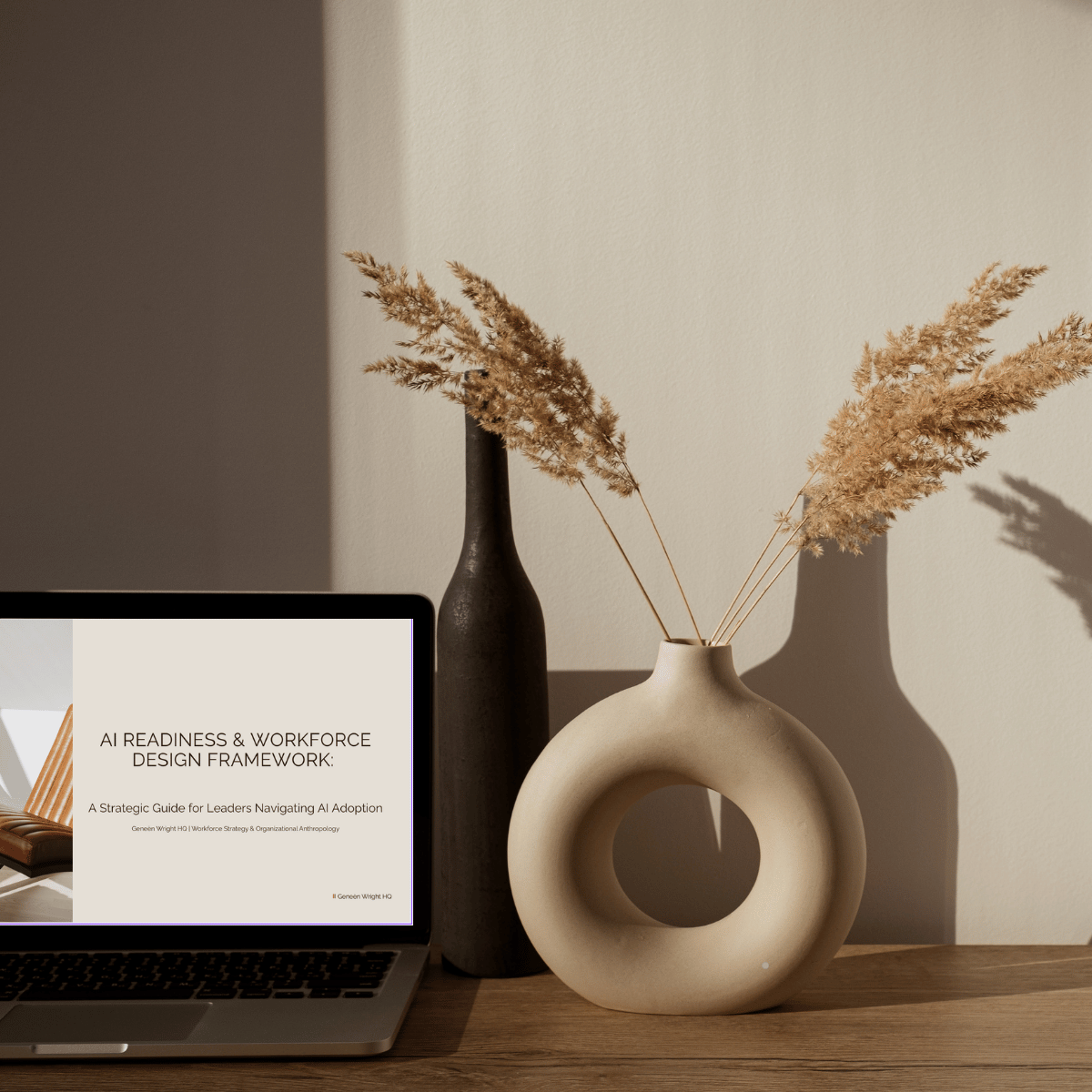
A Strategic Guide for Leaders Navigating AI Adoption
The AI investment is happening. The infrastructure to support it — governance, training, workforce design, compliance — is largely absent. And the gap between those two realities is already showing up in your rework rates, your attrition data, and the trust levels your engagement surveys aren't capturing fast enough.
This framework was built from frontline consulting experience across global organizations navigating AI integration in real time. It maps the structural dimensions that determine whether AI adoption produces transformation or disorientation, pairs 2026 workforce data with diagnostic questions leaders should be asking now, and provides the strategic action architecture to move from reactive adoption to intentional design.
Download the framework. Build the architecture.
Enter your email to receive the AI Readiness & Workforce Design Framework (PDF).
A strategic guide for leaders assessing whether the infrastructure surrounding AI adoption is keeping pace with the investment itself.
Use the framework to examine readiness across workforce design, governance, training, measurement, and the systems that need to support the change.
People by Design
Why Your AI Hiring Stack Needs a Future-Forward People Architecture
Hiring offers a clear example of what happens when new technology meets infrastructure built for earlier conditions. People by Design follows the effects through job architecture, screening logic, human judgment, and the talent an organization is trying to build next.
That may look like:
AI entering core workflows faster than roles are being redesigned
Headcount decisions being considered before task and capability changes are fully understood
Managers taking on new coordination, judgment, or development responsibilities
Existing roles no longer reflecting how work is being performed
New capabilities being introduced without a clear build, buy, redeploy, or redesign strategy
Hiring, performance, succession, or development systems continuing to reinforce an older workforce model
Leadership knowing the organization needs to change, but not yet knowing what should move first
AI Workforce Planning & Transition Strategy is for organizations where changes in the work are beginning to create questions the existing workforce model cannot answer cleanly.
Who This Work Is For
The work typically begins with leaders responsible for workforce, people, operations, transformation, or business strategy who need a clearer read before structural decisions are made.
You do not need a finished AI workforce strategy before we talk.
Bring what is changing in the business, where the pressure is beginning to show up, and the decisions leadership is trying to make. We can start by determining what the conditions are telling you before deciding what needs to move.
Choose a time below for a complimentary 30-minute conversation.
Start With the Read