The Wear. The Tear. The Chasm.
I was an early adopter. Not in the downloading ChatGPT and writing LinkedIn posts about productivity hacks. I mean the kind of early adoption that happens inside organizations when someone realizes that a third of their team's bandwidth is burned on tasks a well-designed workflow could handle in minutes.
I built automations for onboarding sequences, streamlined reporting cadences, created templated systems that gave Talent and HR business partners back hours of their week. This was before "AI strategy" became the talking point du jour. Before every vendor deck led with a generative AI feature nobody asked for and nobody will bother using. It was a simpler time when we had smaller ambitions of removing friction from processes that had calcified over years of organizational neglect.
I welcomed the AI. I championed it. I gave talks on the possibilities and the impact on our quality of work. I discussed the data a well-designed automated flow would produce and more importantly what we could then do with that data to upskill and revamp functions. I built a consulting practice around the premise that technology, deployed with intention, could free the people function to do what it was always supposed to do: think strategically about talent, design equitable systems, and hold organizations accountable to the humans inside them.
Slightly naive? Perhaps. Because what was once a tear — the kind I would eagerly roll up my sleeves to mend — AI laid bare and widened into a gap no patch could hold.
The Gap Between the Mandate and the Infrastructure
When I think about the gap, I imagine a slow-moving bulldozer, revving up. Some people froze with terror. Some got out of the way and watched from the sidelines. Still, others ran back to jump in the driver's seat. But once the bulldozer started rolling, there was no stopping what came next.
Leadership announced AI adoption as a strategic priority. Departments were encouraged, then expected, to integrate AI tools into their workflows. The investment appetite was enormous although governance, quite often, played catch-up.
What I watched unfold, across industries, functions, and levels, was a design problem that led to implementation black holes.
AI was being layered onto broken or lagging systems inside organizations that had never resolved the structural issues underneath: inconsistent data hygiene, fragmented HR systems, unclear ownership of processes, and siloed people functions that were still being treated as administrative cost centers, standing in the background as AI was handed the co-pilot seat and hailed as transformation.
Then the tools arrived, but the training didn't follow. Where it existed at all, it was lackluster at best and forced at worst. The mandates came, with policies that lagged far behind. I have seen it and I have heard it. One function was using AI to screen candidates while the function next door had no idea what was happening. Compensation models were being informed by algorithmic recommendations in one geography and gut instinct in another. The inconsistency was systematized.
This is the part nobody puts in the vendor case study. The organizations getting it wrong share a trait: they confuse adoption with strategy and speed with progress. These are the build-the-plan-while-we-fly-it type of organizations and the impact is telling.
The Numbers Tell the Story We Whisper
The data confirms what practitioners on the ground already knew: adoption outpaced readiness, and readiness was never the priority.
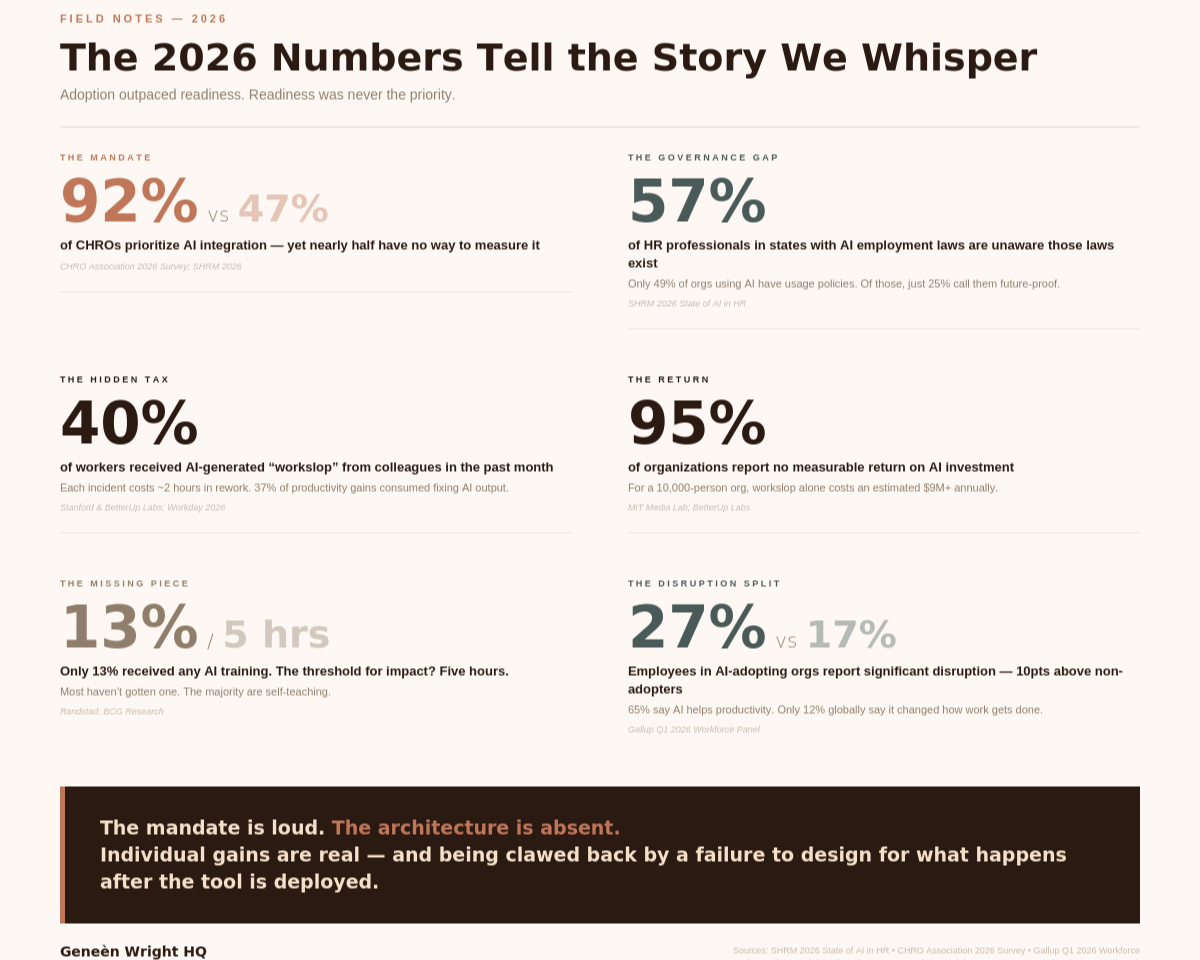
Ninety-two percent of CHROs name AI integration as a top priority; forty-seven percent haven't built a way to measure whether it's working. More than half of HR professionals in states that have already legislated AI employment practices don't know those laws exist. And ninety-five percent of organizations report no measurable return on their AI investment.

A Strategic Guide for Leaders Navigating AI Adoption
The AI investment is happening. The infrastructure to support it — governance, training, workforce design, compliance — is largely absent. And the gap between those two realities is already showing up in your rework rates, your attrition data, and the trust levels your engagement surveys aren't capturing fast enough.
This framework was built from frontline consulting experience across global organizations navigating AI integration in real time. It maps the structural dimensions that determine whether AI adoption produces transformation or disorientation, pairs 2026 workforce data with diagnostic questions leaders should be asking now, and provides the strategic action architecture to move from reactive adoption to intentional design.
Download the framework. Build the architecture.
Enter your email to receive the AI Readiness & Workforce Design Framework (PDF).
Download the Framework
The AI Readiness & Workforce Design Framework maps the five structural dimensions leaders need to assess before layering AI onto their organization: governance, data infrastructure, people function positioning, workforce training, and change architecture. Built from frontline consulting experience and grounded in 2026 workforce data.
Free download with subscription to GWHQ.
The mandate is loud. The architecture is absent. The individual productivity gains are real — and they are being clawed back at the organizational level by a failure to design for what happens after the tool is deployed.
I completed AI fluency and capabilities training this year because I knew the landscape had changed enough that responsible practice required updated literacy. Well, that, and I love tools and tech, so I am constantly learning, using, and designing for tomorrow and yet again tomorrow. But AI pushed a reset like never before. The tools I used three years ago to build workflow automations are already dated. And whereas my vintage Alexander McQueen will serve every time, vintage tech? Just collects dust.
Workslop Will Cost You: The Reality of Time, Materials, and Reputation
The landscape moved fast, and generative AI introduces a fundamentally different set of risks than process automation did: hallucination, bias amplification, intellectual property exposure, and the seductive ease of producing volume without substance.
Researchers at Stanford and BetterUp Labs gave a name to something we have all witnessed and, in some cases, produced: workslop. AI-generated output that appears polished on the surface but lacks the substance, accuracy, or contextual awareness that actual work requires. Do you know it when you see it? And what are you learning from producing it?
The productivity narrative says AI saves time. The workslop data says organizations are spending almost double the time cleaning up after their AI. Employees who receive at least five hours of dedicated AI training show significantly higher quality use and confidence. Yet, most workers haven't received or taken any. The majority are self-teaching and, in some cases, using unsanctioned AI tools for fear of training their AI replacement.
What gets lost in the efficiency conversation is the interpersonal cost. More than half of workers who receive workslop view the sender as less capable and less trustworthy. A third are less likely to collaborate with that colleague again. AI isn't just creating a quality problem. It is corroding the relational fabric that makes teams function. When the tool that was supposed to free people up to think bigger and better actually generates more work and erodes trust, you don't have an AI success story. You have an organizational design failure wearing an expensive tech costume.
The Pattern Underneath
Every major labor transition follows the same architecture: a new capability is introduced, adoption is incentivized before governance is established, the workforce absorbs the cost of the transition gap, and the organizations that survive are the ones that eventually build the infrastructure they should have started with.
The mechanization of factory work in the late 19th century did not fail because the machines would take over. It failed in the places where management treated the machine as a replacement for process design rather than a component of it. Frederick Taylor didn't revolutionize manufacturing by introducing new machines — he redesigned the work itself. And the resistance to Taylorism was that it lacked worker consideration, which made it extraction dressed up as efficiency.
AI in the workplace is running that same sequence, with one notable difference: Taylor at least redesigned the work. A lot of AI adoption isn't even pretending to redesign the work. Organizations are layering tools onto the same old same processes, producing something arguably worse than Taylorism. What remains is the same extractive logic with 0% of the efficiency gains Taylor delivered. What you have now is scalable technology with stagnant organizational design, which will inevitably produce not just slop but a complete breakdown. And the people function? While ostensibly responsible for managing the human side of this transition — is by and large, neither driving the strategy nor adequately included in it. SHRM's 2026 data is plain: HR functions are rarely the primary drivers of AI implementation. IT, legal, and cross-functional task forces lead most aspects of rollout. Yet, HR is being asked to manage the consequences of decisions it didn't shape.
The Wright Way
That paradox is where I step in — at the cross-functional forefront, where planning happens before decisions are handed downstream. Because knowing how to prompt a model is table stakes. Knowing how to evaluate what it produces, when to deploy it, when to override it, and how to build governance around it — that is the work. And that work is what workforce planning has always been responsible for: designing systems that account for human behavior, institutional bias, and the gap between policy and practice.
I go deeper into the historical pattern — from the factory floor to the C-suite — in Career Communiqué, where labor history functions as the diagnostic lens for everything the modern workplace keeps getting wrong. Read more at careercommunique.com. My consultancy uses those cautionary tales to architect what comes next, informed by the patterns of the labor force at large and the specific ones running inside your organization.
“I can build it, but you have to bring it.”
The Opportunity Remains
I'm not here to belabor the headlines. We see them. Whether AI creates or destroys jobs will be answered by how leaders design and plan for it responsibly. Check the Landscape Yourself
Paste this prompt into your AI tool of choice:
“Summarize the latest AI-related workforce and labor market news from the past 30 days. Include layoffs attributed to AI, new roles created by AI adoption, regulatory developments affecting AI in the workplace, and any major employer policy shifts. Use non-partisan sources only: Bureau of Labor Statistics, Reuters, Associated Press, SHRM, the World Economic Forum, Gallup, and major business wire services. Exclude opinion pieces and vendor marketing.”
The landscape moves weekly. Your literacy should too.
The organizations I have seen navigate this well share common infrastructure: they audit their systems before they layer tools on top of them, they invest in training at the same rate they invest in licenses, and they build governance around principles rather than specific tools so their policies survive the next product cycle. In each case, the people function sits at the strategy table, not the implementation table. These are not the organizations making headlines for mass layoffs dressed as innovation.
There is a real threat when it comes to AI, and it is not the technology itself. It is unarchitected and ill-informed adoption. Mandates without training. Deployment without governance. Investment without measurement. And the persistent organizational habit of treating the people function as downstream of decisions that reshape every role in the company.
Looking back, I built those early automations because I believed (I still believe) that technology deployed with intention can make organizations more equitable, more efficient, and more capable of serving the humans inside them. That belief hasn't changed. The landscape around it has. And the practitioners, HR leaders, and workforce strategists who will shape what comes next are the ones investing in their own fluency, insisting on a seat at the design table, and refusing to let adoption outrun architecture.
The tools are here. The question is whether we'll build the infrastructure to match them, or repeat the same tired pattern we've been running since the first factory floor.
Sure, it works, until things fall apart.
A Strategic Guide for Leaders Navigating AI Adoption
The AI investment is happening. The infrastructure to support it — governance, training, workforce design, compliance — is largely absent. And the gap between those two realities is already showing up in your rework rates, your attrition data, and the trust levels your engagement surveys aren't capturing fast enough.
This framework was built from frontline consulting experience across global organizations navigating AI integration in real time. It maps the structural dimensions that determine whether AI adoption produces transformation or disorientation, pairs 2026 workforce data with diagnostic questions leaders should be asking now, and provides the strategic action architecture to move from reactive adoption to intentional design.
Download the framework. Build the architecture.
Enter your email to receive the AI Readiness & Workforce Design Framework (PDF).